
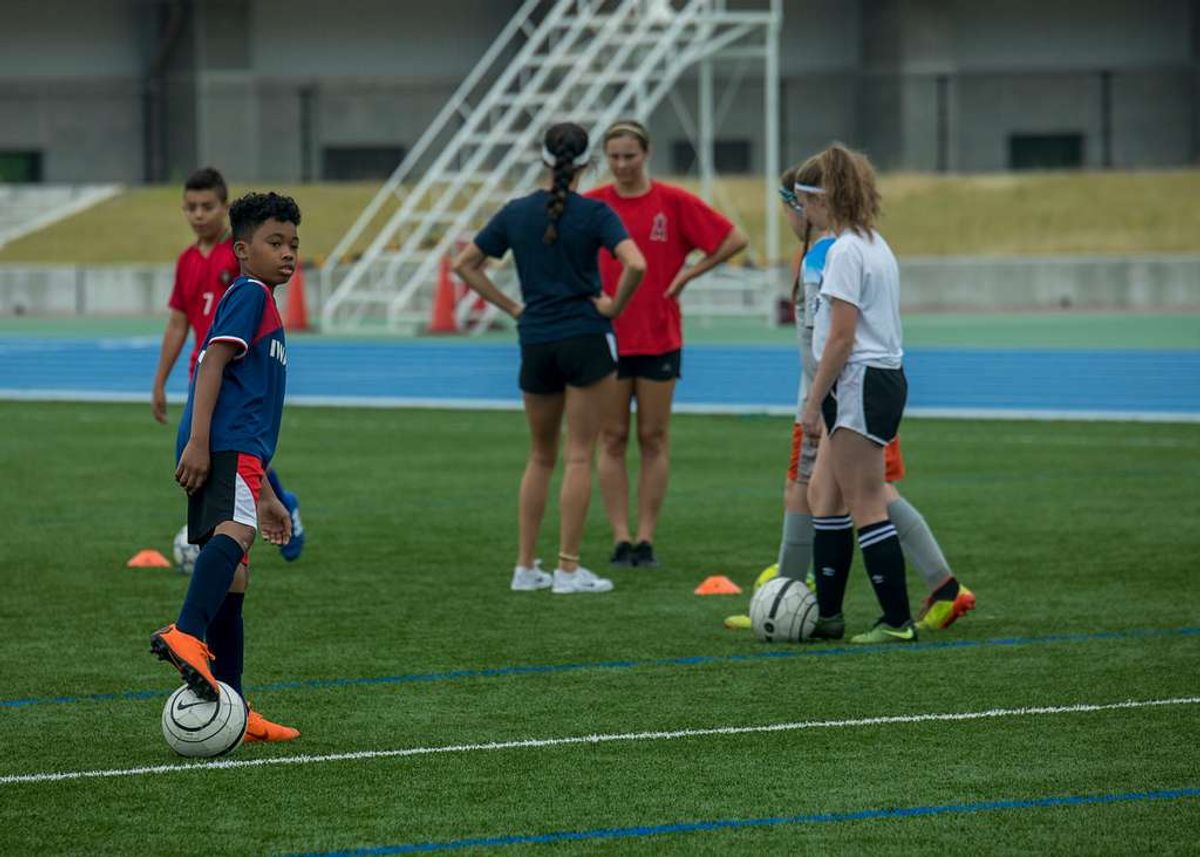
Soccer drills are an essential component of training for soccer players of all levels. In this article, we will explore key aspects of maximizing your training through effective drills, focusing on warm-up drills, team communication, and technical skills development.
Key Takeaways
- Dynamic stretching, agility exercises, and ball control drills are crucial for warming up before soccer training sessions.
- Passing patterns, small-sided games, and communication drills can enhance team communication and coordination on the field.
- Dribbling techniques, shooting accuracy, and first touch training are key for developing technical skills in soccer.
- Consistent practice and repetition are essential for improving performance in soccer drills.
- Effective communication and feedback among teammates and coaches can lead to better execution of soccer drills.
The Importance of Warm-Up Drills
Dynamic Stretching
We understand the importance of starting our training sessions with the right foot, and that begins with dynamic stretching. Dynamic stretches are crucial as they prepare our muscles for the intense activity ahead. Unlike static stretches, these movements enhance our flexibility and increase blood flow, which is essential for peak performance.
- Arm circles
- Leg swings
- Lunges with a twist
- High knees
Dynamic stretching not only primes our muscles but also sharpens our mental focus. We become more attuned to our bodies and the demands of the game.
By incorporating a variety of dynamic stretches, we ensure that every muscle group is activated. This approach helps us to ‘Warm Up Like a Pro!‘ and is a key strategy to prevent soccer injuries. Remember, it is highly recommended to perform dynamic stretches rather than static ones before a game.
Agility Exercises
After warming up our muscles with dynamic stretching, we focus on enhancing our agility—a crucial aspect of soccer that often tips the scales in high-pressure situations. Agility exercises are designed to improve our ability to change direction quickly and efficiently on the field.
- Ladder drills for fast feet
- Cone drills for directional changes
- Shuttle runs for explosive speed
Agility is not just about speed; it’s about control. Mastering these exercises will give us the edge we need to outmaneuver opponents.
Incorporating these drills into our regular training sessions will ensure that we’re not just fast, but also precise in our movements. Remember, the goal is to translate this agility into actual game scenarios, where quick thinking and rapid changes in direction can make all the difference.
Ball Control Drills
After focusing on agility and dynamic stretching, we turn our attention to ball control drills, which are essential for maintaining possession and dictating the pace of the game. We incorporate exercises that simulate match conditions to ensure our players can apply these skills under pressure.
One effective drill we use is the ‘Ball Control 1-on-1 Drill‘, inspired by Megan Wargo-Kearney. It’s a flexible exercise that enhances a player’s ability to read the game, providing them with multiple touches and decision-making opportunities. Here’s a simple breakdown of the drill:
- Each player faces a partner across a small grid.
- Players take turns sending the ball to each other, using various parts of the foot.
- The receiving player must control the ball and return it accurately.
This drill not only improves ball handling but also sharpens a player’s anticipation and reaction time.
By regularly incorporating these drills into our training sessions, we ensure that our players are adept at controlling the ball in tight spaces, which is a crucial aspect of modern soccer.
Enhancing Team Communication
Passing Patterns
Incorporating passing patterns into our training sessions is crucial for developing our team’s ability to maintain possession and move the ball effectively under pressure. We focus on a variety of patterns to enhance our players’ spatial awareness and decision-making skills.
- Start with simple patterns and gradually increase complexity.
- Emphasize the importance of timing and accuracy.
- Encourage players to communicate verbally and non-verbally.
By consistently practicing passing drills, we build a strong foundation for our team’s playmaking abilities. It’s not just about the pass itself, but also about understanding the movement of teammates and anticipating the opponent’s actions.
Remember, the goal is to create a fluid and intuitive passing network on the pitch that can adapt to any situation during a match. This requires patience and repetition, but the payoff is a cohesive team that works like a well-oiled machine.
Small-Sided Games
In our training sessions, we’ve found that small-sided games are incredibly effective for enhancing team communication. These games create a more intimate setting where players are constantly involved and must make quick decisions. The constant interaction fosters better understanding among teammates, leading to a more cohesive unit on the pitch.
Communication is key in these drills, and we emphasize verbal and non-verbal signals. Players learn to read each other’s movements and intentions, which translates to improved performance during official matches.
- Encourage players to call for the ball
- Stress the importance of eye contact
- Rotate positions to understand different roles
By reducing the number of players, each individual gets more touches on the ball, which not only improves their technical skills but also their ability to communicate under pressure.
Remember, the goal is not just to win these small-sided games, but to develop a level of understanding that can be a game-changer during competitive play.
Communication Drills
After focusing on the technical aspects of soccer, we understand that effective communication is the bedrock of a successful team. We incorporate specific drills that emphasize communication skills during our training sessions. These exercises are not just about talking, but also about understanding and anticipating each other’s moves on the pitch.
- Call out names when passing the ball
- Use hand signals to indicate movement
- Establish eye contact before making a play
By consistently practicing these drills, we foster an intuitive sense of teamwork that becomes second nature during matches.
Remember, a team that communicates well can adapt quickly to any situation on the field. It’s not just about the individual skill but how we connect as a unit that makes us formidable opponents.
Developing Technical Skills
Dribbling Techniques
We understand the pivotal role that dribbling plays in soccer, which is why we focus on drills that enhance close ball control and quick direction changes. Mastering dribbling is essential for evading defenders and creating opportunities on the pitch.
- Start with cone drills to improve agility and ball handling.
- Progress to one-on-one situations to simulate match conditions.
- Incorporate speed dribbling to boost your ability to move the ball quickly under pressure.
Remember, the key to effective dribbling is not just speed, but also the unpredictability of your movements.
By consistently practicing these exercises, we’ll develop the finesse and confidence needed to take on any opponent. As we delve into various drills, we aim to elevate our game to the next level, much like the youth soccer drills highlighted by SportsEdTV.
Shooting Accuracy
After honing our dribbling skills, we turn our focus to shooting accuracy. It’s crucial for us to convert chances into goals, and that requires precision and control. We start by setting up drills that simulate match conditions, ensuring that our strikers and midfielders get ample opportunities to strike the ball cleanly towards goal.
Consistency is key in shooting drills. We track our progress through a series of metrics, such as shots on target, conversion rate, and shot power. Here’s a simple table to record our weekly shooting practice outcomes:
| Week | Shots on Target | Conversion Rate | Shot Power |
|---|---|---|---|
| 1 | 75% | 20% | High |
| 2 | 80% | 25% | High |
| 3 | 85% | 30% | Very High |
To truly master the pitch, we must ensure that our defensive drills also prioritize safety and proper technique, just as much as we focus on offensive prowess.
We also incorporate a variety of shooting exercises, such as:
- Stationary shooting from different angles
- Moving targets to mimic defenders
- Timed shooting challenges to add pressure
By the end of our sessions, we aim to see a noticeable improvement in our ability to find the back of the net under various conditions.
First Touch Training
Mastering the first touch is crucial for maintaining possession and creating opportunities on the field. We must train to control the ball effectively with a single touch, setting ourselves up for the next move. This skill is particularly vital in high-pressure situations where space and time are limited.
To enhance our first touch, we can practice the following drills:
- Receiving and controlling aerial balls from different angles
- Using various parts of the body to settle the ball quickly
- Redirecting the ball into space with the first touch to evade defenders
Consistent practice of these drills will lead to smoother transitions in play and a more fluid game overall. It’s not just about stopping the ball dead; it’s about preparing for that next pass or shot.
Remember, the quality of your first touch can dictate the tempo of the game and your ability to outplay the opposition. Let’s incorporate these drills into our regular training sessions to see significant improvements on the pitch.
Conclusion
In conclusion, effective soccer drills are essential for maximizing your training and improving your skills on the field. By incorporating a variety of drills that focus on different aspects of the game, you can enhance your agility, speed, technique, and overall performance. Remember to stay consistent, challenge yourself, and seek guidance from experienced coaches or resources like Soccer Rondo for additional tips and insights. With dedication and the right approach to training, you can take your soccer game to the next level.
Frequently Asked Questions
What are the best warm-up drills before a soccer training session?
Dynamic stretching, agility exercises, and ball control drills are highly recommended for warming up before soccer drills.
How can team communication be improved during soccer drills?
Team communication can be enhanced through passing patterns, small-sided games, and communication drills that focus on effective communication on the field.
What are some key technical skills to develop for soccer players?
Important technical skills to develop include dribbling techniques, shooting accuracy, and first touch training to improve overall performance on the field.
How often should soccer players incorporate warm-up drills into their training routine?
It is recommended that soccer players incorporate warm-up drills before every training session to prevent injuries and prepare the body for physical activity.
What is the significance of team communication in soccer drills?
Effective team communication is crucial in soccer drills as it promotes coordination, collaboration, and unity among team members on the field.
How can soccer players benefit from technical skill development in training drills?
Improving technical skills through training drills can lead to better ball control, decision-making, and overall performance during matches.